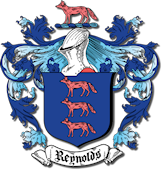
| |
Reynolds in the Military
Reynolds family descendants have served in the military in all ranks and in all the major British and American wars, including:
American Revolutionary War
The American Revolutionary War (1775–1783), also known as the American War of Independence, was a war between Great Britain and revolutionaries within thirteen British colonies, who declared their independence as the United States of America in 1776.
The war was the culmination of the American Revolution, a colonial struggle against political and economic policies of the British Empire. The war eventually widened far beyond British North America; many Native Americans also fought, on both sides of the conflict.
Throughout the war, the British were able to use their naval superiority to capture and occupy coastal cities, but control of the countryside (where most of the population lived) largely eluded them. After an American victory at Saratoga in 1777, France, Spain, and the Netherlands entered the war against Great Britain. French involvement proved decisive, with a naval victory in the Chesapeake leading to the surrender of a British army at Yorktown in 1781. The Treaty of Paris in 1783 recognized the independence of the United States.
—Wikipedia
War of 1812
The War of 1812 (in Britain, the American War of 1812 to 1815), was fought between the United States and the British Empire from 1812 to 1815, on land in North America and at sea. The war ended as a stalemate, with no territory changing hands. The United States, which declared war and attacked British colonies and shipping first, ended the war without gaining any territory; however, the British ceased the sovereignty violations, to which the United States had objected, two days prior to the war.
Some histories refer to this war as the "War of 1812–14", using the date of the peace treaty as the ending date of the war.
—Wikipedia
Mexican-American War
The Mexican-American War was fought between the United States and Mexico in the years 1846 to 1848. It is also referred to as the U.S.-Mexican War or (from a U.S. perspective) the Mexican War; contemporary critics called it Mr. Polk's War. In Mexico, it is called La Guerra de Intervención Norteamericana (the War of North American Intervention).
The war arose from the competing claims to Texas by Mexico and the United States in the wake of the Texas Revolution. Texas fought a war of independence against Mexico, but Mexico considered Texas a "breakaway province" and refused to recognize its independence. The root causes included westward migration by Americans and political instability in Mexico in the aftermath of the Mexican War of Independence, which made it difficult for the United States to negotiate with Mexico and for Mexico to administer its northern territories. Texans strongly favored a war with Mexico, and received the support of Anglos living in California and New Mexico. The war was bitterly debated inside the U.S.; in Mexico it was considered a matter of defensive necessity.
The most important consequence of the war was the Mexican Cession, in which the Mexican territories of California and New Mexico were sold to the U.S. and recognition was granted to the annexation of the Republic of Texas.
—Wikipedia
American Civil War
The American Civil War (1861–1865) was a sectional conflict in the United States between the Federal government ("Union") and 11 southern slave states that declared their secession and formed the Confederate States of America, led by President Jefferson Davis. The "Union", led by President Abraham Lincoln and the Republican party which opposed expansion of slavery, rejected any right of secession. Fighting began April 12, 1861 when Confederate forces attacked a Federal fort at the Battle of Fort Sumter.
In the first year the Union asserted control of the border states and established a naval blockade as both sides raised large armies. In 1862 the large, bloody battles began. After the Battle of Antietam in September 1862, Lincoln's Emancipation Proclamation made the freeing of the slaves a war goal — one bitterly opposed by Copperheads. Emancipation ensured that Britain and France did not intervene to help the Confederates. In the East, Robert E. Lee rolled up a series of Confederate victories over a series of Union commanders, but his best general, Stonewall Jackson, was killed at the Battle of Chancellorsville in May 1863. Lee's invasion of the North was repulsed at the Battle of Gettysburg in July 1863; he barely managed to escape back to Virginia. In the West, the Union Navy captured New Orleans in 1862, and armies under Ulysses Grant seized control of the Mississippi River by capturing Vicksburg in July 1863, thus splitting the Confederacy.
By 1864 long-term Union advantages in geography, manpower, industry, finance, political organization and transportation were overwhelming the Confederacy. Grant fought a bloody series of battles with Lee in Virginia in summer 1864. Lee won in a tactical sense but lost strategically, as he could not replace his casualties and was forced to retreat into trenches around his capital, Richmond, Virginia. Meanwhile William T. Sherman captured Atlanta and marched to the sea, destroying a wide swath of Georgia. In 1865 the Confederacy collapsed as Lee surrendered and all the slaves were freed.
The full restoration of the Union was the work of a highly contentious postwar era known as Reconstruction. The war produced more than 970,000 casualties (3% of the population), including approximately 620,000 soldier deaths—two-thirds by disease. The causes of the war, the reasons for the outcome, and even the name of the war itself, are subjects of lingering controversy, even today. The main results of the war were the restoration and strengthening of the Union, and the end of slavery in the United States.
—Wikipedia
Spanish-American War
The Spanish-American War took place in 1898, and resulted in the United States gaining control over the former colonies of Spain in the Caribbean and Pacific. The US lost 379 troops in combat and over 5,000 to disease. As a result of the war, Cuba would be declared independent in 1902.
—Wikipedia
First World War
The First World War, also known as The Great War, The War to End All Wars, and World War I (abbreviated WWI) was a global military conflict that took place between 1914 and 1918. It was a total war which left ten million dead and shaped the modern world.
The Allied Powers, led by Britain, France, Russia, and later also the United States, defeated the Central Powers, led by Germany, Austria-Hungary and the Ottoman Empire. The Allied powers before 1917 are sometimes referred to as the Triple Entente, and the Central Powers are sometimes referred to as the Triple Alliance.
Much of the fighting in World War I took place along the Western Front, within a system of opposing manned trenches and fortifications (separated by a "No man's land") running from the North Sea to the border of Switzerland. On the Eastern Front, the vast eastern plains and limited rail network prevented a trench warfare stalemate from developing, although the scale of the conflict was just as large. Hostilities also occurred on and under the sea and — for the first time — from the air. More than 9 million soldiers died on the various battlefields, and nearly that many more in the participating countries' home fronts on account of food shortages and genocide committed under the cover of various civil wars and internal conflicts. Notably, more people died of the worldwide influenza outbreak at the end of the war and shortly after than died in the hostilities.
The war caused the disintegration of four empires: the Austro-Hungarian, German, Ottoman, and Russian. Germany lost its overseas empire, and new states such as Czechoslovakia, Poland, and Yugoslavia were created.
Ultimately, World War I created a decisive break with the old world order that had emerged after the Napoleonic Wars, which was modified by the mid-19th century's nationalistic revolutions. The results of World War I would be important factors in the development of World War II approximately 20 years later.
—Wikipedia
Second World War
World War II, also known as the Second World War or WWII, was a global military conflict that took place between 1937 and 1945. It was the largest and deadliest war in history, culminating with the dropping of the atomic bomb.
The Allied Powers, led by Britain, Canada, the Soviet Union (1941) and the United States (1941), defeated the Axis Powers, led by Germany, Italy, and Japan. The war was fought in response to the expansionist and racist aggression of Nazi Germany under the dictator Adolf Hitler and the imperial ambitions of Japan in Asia.
It is possible that around 62 million people, or 2% of the world population, died in the war; estimates vary greatly. About 60% of all casualties were civilians, who died as a result of disease, starvation, genocide (in particular, the Holocaust), massacres, and aerial bombing.
After World War II, Europe was informally split into Western and Soviet spheres of influence. There was a shift in power from Western Europe and the British Empire to the two new superpowers, the United States and the Soviet Union.
In Asia, the defeat of Japan led to its democratization. China's civil war continued through and after the war, resulting eventually in the establishment of the People's Republic of China. The former colonies of the European powers began their road to independence.
—Wikipedia
| |